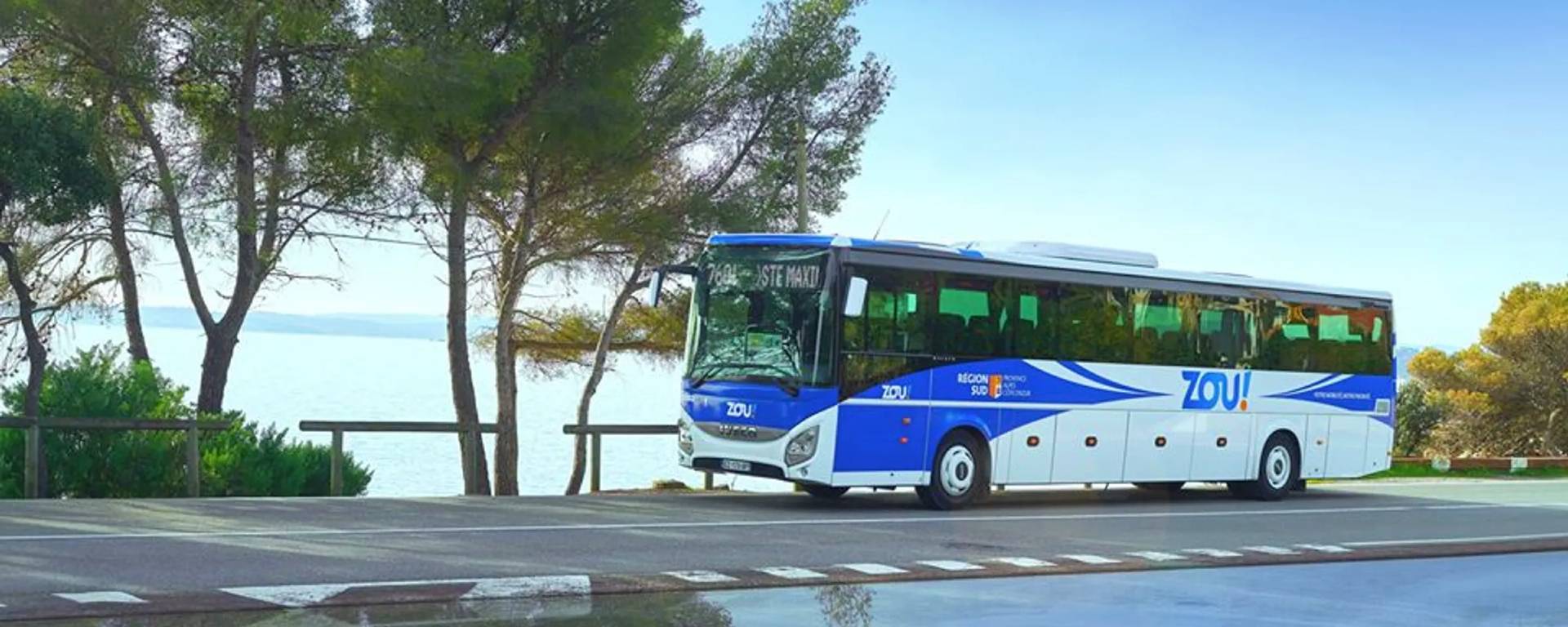
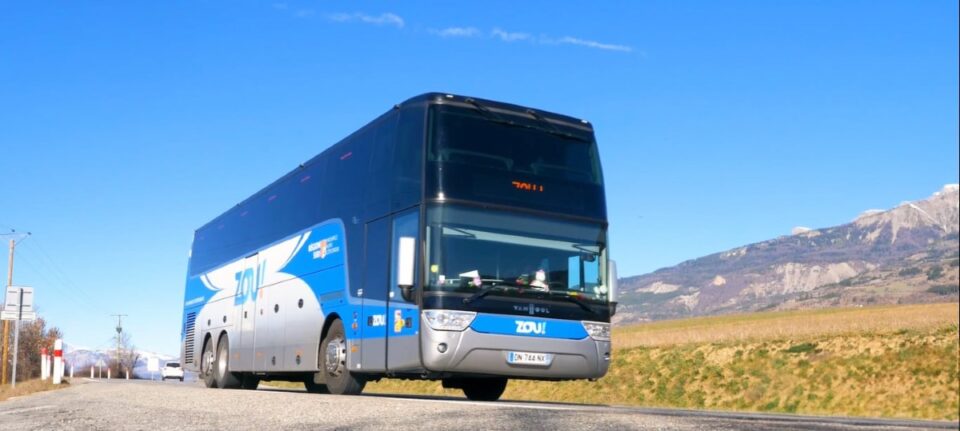
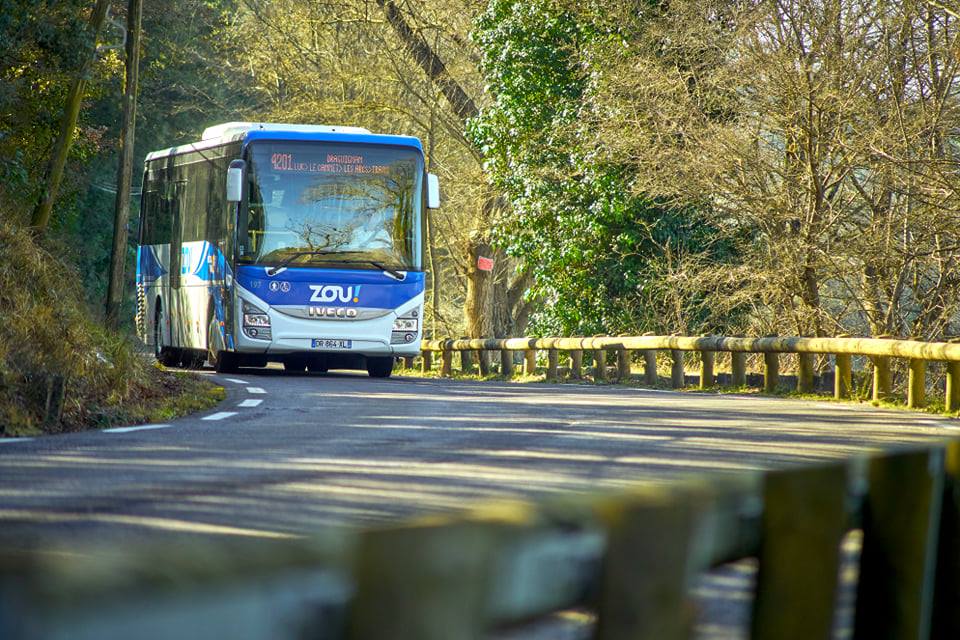
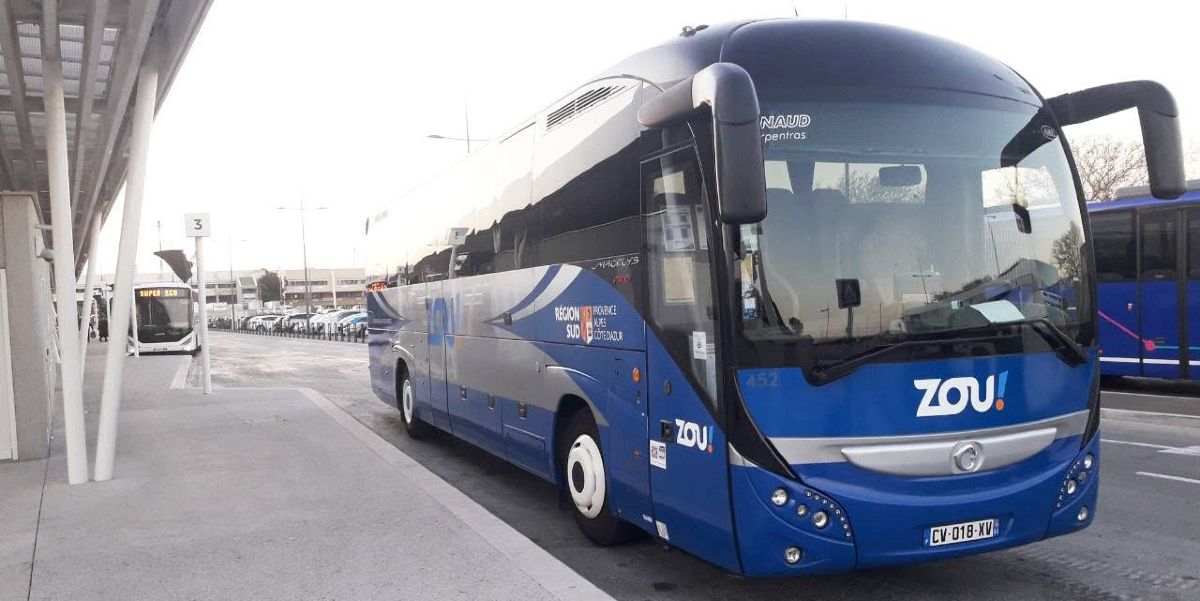
The ZOU! network organises bus and coach services across the Provence-Alpes-Côte d’Azur (PACA) region. Here we take a closer look at its regional organisation, the network by department and the regional express routes, designed to provide easy connections between towns and key locations (railway stations, airports).
Since 2018, the Provence-Alpes-Côte-d’Azur region has brought together all its non-urban rail and road transport services under the ZOU! brand, with a view to simplifying passenger information and standardising services across the six departments.
What the ZOU! brand stands for
The ZOU! brand was created as part of a policy initiative: to bring all regional public transport services – whether rail or road – under a single identity. Prior to this rebranding, passengers had to navigate between several brands and networks, each with its own branding, fares and information channels.
ZOU! thus brings together the former departmental and regional brands: TER (Regional Express Trains), LER (Regional Express Bus Routes), Chemins de Fer de Provence (the historic Nice–Digne line), Cartreize (Bouches-du-Rhône), Varlib (Var), TransVaucluse (Vaucluse), as well as the networks in the Alpes-de-Haute-Provence, Hautes-Alpes and Alpes-Maritimes. This merger makes it easier to navigate the network, regardless of the mode of transport or the department being travelled through.
The ZOU! multimodal service covers several types of service:
TER trains on the main rail routes
intercity coaches for providing detailed regional services
Express services for fast journeys between major cities
school services for pupils and students
certain special services to airports and TGV stations.
This integrated approach makes it easier to make connections and allows passengers to combine train and coach journeys within a single trip, with harmonised fares.
6 departments covered: Bouches-du-Rhône, Var, Vaucluse, Alpes-Maritimes, Alpes-de-Haute-Provence, Hautes-Alpes.
Official launch: 1 September 2018.
Legal scope: transfer of inter-departmental routes from the departments to the region under the NOTRe Act (New Territorial Organisation of the Republic* ).
The Provence-Alpes-Côte d’Azur Region is the transport organising authority ( AOT* ) within its territory. It draws up master plans for transport routes, sets fares, negotiates public service contracts and coordinates the various operators. This responsibility was transferred to it by central government as part of the 2015 territorial reform, which made the regions the lead bodies for inter-city transport.
The service is operated by a number of private and public transport operators, organised into regional lots. The main operators include Transdev (through its subsidiaries Transdev Vaucluse, Transdev Alpes Provence, Transdev Var and Transdev Dauphiné), Keolis, as well as independent local transport operators. These public service concession contracts are generally multi-year (5 to 8 years), with performance obligations relating to punctuality, quality of service and the energy transition (less polluting vehicles, biofuels, etc.).
Network governance also relies on shared digital tools: a regional journey planner incorporating all public transport services (rail and road) from the various transport authorities, open data (GTFS, GeoJSON) updated daily, and a unified customer service available by telephone and online.
Key figures ( 2025)
1,700 buses in service across the entire network
200 regular routes (excluding school services)
650 school bus routes, carrying around 50,000 pupils every day
90 transport operators, spread across the six departments
16 Express routes serving more than 300 local authorities across the region
~17 million bus and coach journeys per year.
The ZOU! Express services: their role and how they work
The Express routes form the backbone of the road network: they link urban areas together and serve major regional centres of interest, with fares based on distance.
Purposes and types of transport services
The ZOU! Express routes have been designed to meet a specific need: to provide a fast and comfortable road transport alternative to overcrowded or non-existent rail links, whilst connecting the region’s major cities with one another and with key destinations (international airports, TGV stations, major rail hubs).
The official numbering of Express routes ranges from 1 to 99, according to data published by the PACA Region. In practice, routes commonly identified as ‘Express’ fall within the 50–99 range, whilst local routes (providing detailed coverage of local areas) are numbered from 100 to 999, and school routes from 1000 to 9999. This structure enables passengers to quickly identify the type of service on offer.
Fares on Express routes are based on the distance travelled, in accordance with inter-city transport regulations. They are separate from urban fares and may vary depending on the route, particularly for airport services, which sometimes include specific surcharges. Passengers can choose between single tickets, travel booklets, monthly or annual season tickets, as well as additional schemes offering discounts subject to certain conditions.
The vehicles used on Express routes are generally the latest generation of luxury coaches or intercity coaches, equipped with air conditioning, USB sockets, on-board Wi-Fi (depending on the route) and, of course, guaranteed seating. Some operators have introduced vehicles running on biofuel or with low emissions to reduce the network’s environmental impact.
Regional Express Services
Coverage: 16 Express routes serving more than 300 local authorities across the region.
Accessibility: 100 per cent of vehicles and stops are accessible to people with reduced mobility (a regulatory requirement).
An Express network organised by routes and by department
The ZOU! Express routes form a network of express routes that criss-cross the entire Provence-Alpes-Côte d’Azur region, linking major urban areas, Alpine valleys and the main rail and airport hubs. These routes, numbered from 50 to 99 (with a few extensions beyond this range), serve more than 300 local authorities across the entire region. They are organised by major inter-city routes, but are also categorised by department, making them easier to understand for both local residents and tourists.
List of regional Express routes (overview)
The list below sets out the Express ZOU! routes as they appear in recent regional documents (maps, timetables, open data), with simplified names for the terminus stations and the main route served.
Line 50 ZOU!: Marseille ⇆ Ski resorts in the Southern Alps (seasonal services to the Alpine ski areas)
Line 51 ZOU!: Nice ⇆ Grenoble via Digne and Sisteron (Alpes-de-Haute-Provence / Hautes-Alpes route).
Route 892 ZOU!: Saint-Maximin ⇆ Gardanne, from 1 September 2026.
In total, the regional Express network comprises between 16 and 20 main routes, depending on the season and year, with variations or extensions during certain periods (summer/winter for mountain resorts, summer for certain tourist routes).
A practical guide to reading the numbers
50–69: major inter-city routes in Provence-Alpes (Marseille, Avignon, Aix, Digne, Barcelonnette, Briançon).
70–79: internal Alpine routes (Gap, Serre-Chevalier, Saint-Michel-Valloire, the Hautes-Alpes valleys).
80–83 / 90: coastal and airport connections around Nice, Cannes, Monaco and Saint-Raphaël.
90+: extensions and new routes (93, 94, 892) improving connections between the Var and Bouches-du-Rhône departments.
All these routes form part of the ZOU! Express intercity network, which is separate from local routes (100–999) and school routes (1000+).
Express routes by main service area
Most routes pass through several departments, but it is possible to group them by reference area (the departments mainly affected), which makes them easier to follow when planning journeys and travel.
Alpes-de-Haute-Provence (04)
The Alpes-de-Haute-Provence region lies at the heart of the express road network, with several routes linking Digne-les-Bains, Manosque, Barcelonnette and the Alpine valleys to Marseille, Avignon and Grenoble.
Line 51 ZOU!: Nice ⇆ Grenoble via Digne and Sisteron (Alpes-de-Haute-Provence / Hautes-Alpes route).
Route 65 ZOU!: Marseille ⇆ Forcalquier via Manosque (Durance and eastern Luberon route).
Line 66 ZOU!: Digne-les-Bains ⇆ Marseille Provence Airport via Manosque and Aix TGV (airport link)
Route 67 ZOU!: Marseille ⇆ Riez via Gréoux-les-Bains (spa and rural services)
Gap and Briançon are the two hubs of the Express network in the Hautes-Alpes (05)
Bus route 69 provides a direct road link between Marseille and Briançon, complementing the TER rail service.
Bus routes 55 and 71 provide regular services to the Isère region and the Alpine resorts.
Alpes-Maritimes (06)
In the Alpes-Maritimes, the Express lines serve both coastal destinations (airport connections) and mountain destinations (ski resorts and Alpine valleys).
Line 51 ZOU!: Nice ⇆ Grenoble via Digne and Sisteron (Alpes-de-Haute-Provence / Hautes-Alpes route).
Line 60 ZOU!: Nice ⇆ Aix-en-Provence (cross-regional service between the Côte d’Azur and Provence)
The Express coastal routes serve the main tourist destinations: Cannes, Antibes, Monaco and Menton
The mountain routes (51, 83) link Nice to the Southern Alps and the ski resorts.
Bouches-du-Rhône (13)
The Bouches-du-Rhône department is home to several ZOU! Express network hubs, notably Marseille and Aix-en-Provence, which serve the Var, Vaucluse and Alpes regions.
Line 50 ZOU!: Marseille ⇆ Ski resorts in the Southern Alps (seasonal services to the Alpine ski areas)
Marseille and Aix-en-Provence are the termini for at least nine Express routes (50, 57, 59, 60, 63, 65, 66, 67, 68, 69, 94)
Marseille Provence Airport is directly connected to Digne-les-Bains and the Durance corridor via bus route 66
The Express services complement the TER train on the Marseille–Avignon, Marseille–Gap/Briançon and Marseille–Manosque routes.
Var (83)
The Var is served by express services running both along the coast and inland, linking Toulon, Saint-Raphaël and Brignoles to Aix-en-Provence, Marseille and Nice.
Route 59 ZOU!: Aix-en-Provence ⇆ Toulon via Brignoles (Bouches-du-Rhône – Var route)
Route 90 ZOU!: Saint-Raphaël ⇆ Nice Airport (coastal service between the Var and Alpes-Maritimes departments)
Avignon and Carpentras are the terminus stations for three major Express routes (57, 62, 63)
The Vaucluse is connected to both the Alps (Digne, Forcalquier) and Aix-en-Provence via the Express lines
These services complement the Avignon–Marseille and Avignon–Carpentras TER services.
Practical information on using the network
To make the most of your journeys on ZOU! buses and coaches, here are some useful tips on buying tickets, real-time information and specific services (school transport, TAD, etc.) to help you travel conveniently across the Provence-Alpes-Côte-d’Azur network.
Tickets and fares
The ZOU! fare scheme is valid across all the networks listed (TER, LER, intercity coaches, school buses), which makes things much simpler for regular passengers. Tickets can be purchased online via the official website, at coach stations, from drivers (depending on the route), or via dedicated mobile apps.
Single tickets Valid for a single journey on a specific route, single-journey tickets can be purchased in advance online or directly from the driver (with a surcharge in some cases). The price depends on the distance travelled, with reduced fares for longer journeys.
Travel booklets Available on certain routes, such as those to Nice Airport, these 10-trip booklets offer a discount compared to the single-trip fare. They are valid for a set period (usually three months) and can be used by several people at the same time.
Monthly and annual subscriptions Regular users can take out monthly subscriptions (valid for one calendar month) or annual subscriptions (valid for 12 months from the date of purchase). Prices vary according to age and status:
Standard monthly pass: personalised card, valid on one route for one calendar month.
Youth monthly pass: fares for under-26s.
Annual subscription: per year + administration fee.
Malin and Solidaire Cards The ZOU! Malin card offers a 50 per cent discount on all journeys and a 75 per cent discount on a specific, fixed route when you buy a book of ten tickets. The ZOU! Solidaire card is for people eligible for social assistance and offers additional reduced fares.
Zou! Studies Pass Secondary school pupils, sixth-form students, university students, apprentices and trainees on vocational training courses aged under 26 are eligible for the Pass Zou! Studies, which allows them to travel free of charge between their home and place of study and to benefit from a 50 per cent discount on their other journeys.
Special fares for airport routes Certain routes serving airports in the PACA region (notably Nice Côte d’Azur) apply specific flat-rate fares, with a mini-group option (3 to 9 people travelling together from €45) and surcharges for animals (per animal; free for guide dogs).
Indicative prices (2026)
Purchasing & information
Official website: online ticketing, timetables, maps, journey planner ↗
☎ ZOU! Customer Service 04 13 94 30 50 (every day from 7 am to 8 pm, charged at local rates) Research: 04 86 88 50 50 (Monday to Friday, 8 am to 6 pm) Charity: 04 13 94 30 50 (Monday to Friday, 9 am to 6 pm) ✉ via the form ↗
Points of sale: tickets and information available online and at major railway stations (Toulon, Marseille, Nice, Avignon, Gap, etc.), and at ZOU! sales offices ↗
Allez ZOU! app: journeys, real-time information, favourites, e-tickets – available on Android and the App Store
Specific services: schools, distance learning
School bus routes (nos. 1000 to 9999) The ZOU! network comprises a dense network of school bus routes, providing comprehensive coverage of secondary schools across all six departments. Registration is compulsory via the Region’s official website, and the necessary procedures must be completed before the start of the school year (usually by the end of June). The PACA Region is the organising authority for school transport, with the exception of school transport for pupils with disabilities, which remains a departmental responsibility.
On-Demand Transport (ODT) Some sparsely populated areas or mountainous regions benefit from Transport on Demand (TAD ↗) services, allowing users to book a journey by coach or minibus at a time and from a stop of their choice, within specified time slots. Bookings can be made via the ZOU! customer service line on 04 13 94 30 50, from 7 am to 8 pm.
These developments are part of a wider effort to optimise the network, involving the reallocation of resources to the busiest routes and adapting to new mobility needs (remote working, sustainable tourism, etc.).
Points to bear in mind
Always check that the timetables are up to date, particularly during periods of engineering works or seasonal reorganisation. Timetables are available online, on the app and at stations.
For airport routes ( such as Nice), expect special fares and booking restrictions. Certain routes (80, 81, 82) charge flat-rate fares and surcharges.
Accessibility: 100% of vehicles and stops are accessible to people with reduced mobility, but it is advisable to check the access arrangements for specific stops (platforms, ramps, etc.).
Pets: Pets are permitted on board subject to certain conditions (they must be carried in cages or kept on a lead), with a surcharge of €5 per pet (free of charge for guide dogs).
ZOU! and the green transition: commitments and prospects
The ZOU! network is part of an ecological transition initiative, with quantified targets for reducing greenhouse gas emissions, promoting sustainable transport and ensuring accessibility for all.
Less polluting vehicles and biofuels
Several network operators have introduced vehicles running on biofuel (B100) or low-emission vehicles (Euro 6, electric, hybrid) to reduce the environmental impact of express and intercity routes. For example, Transdev Vaucluse operates an express route between Forcalquier and Marseille using biofuel-powered vehicles, thereby reducingCO₂ emissions by more than 80 per cent compared with conventional diesel.
The Region has also issued calls for tenders for the renewal of its bus fleet, with strict environmental criteria (Euro 6 standards, electric or hybrid vehicles, regenerative braking systems, etc.). These investments form part of the region’s Regional Economic Development Plan (SRDE), which aims to achieve carbon neutrality by 2050.
Intermodality and sustainable transport
The ZOU! network encourages intermodal travel with other modes of transport (train, cycling, car-sharing, car-sharing schemes) to reduce reliance on private cars. Several coach stations are equipped with secure bike lock-ups, charging points for electric vehicles and dedicated car-sharing areas. On many routes, you can book a space to transport your bike, whether bybus↗ ortrain↗.
Trials are currently underway to integrate car-sharing services (Blablacar Daily, Klaxit, etc.) into the regional journey planner, enabling users to compare different transport options (bus, train, car-sharing, cycling) and choose the one best suited to their needs.
Accessibility and social inclusion
Accessibility for people with reduced mobility (PRM) is a priority for the ZOU! network, with 100 per cent of vehicles and stops complying with current regulations. Access ramps, priority seating, audio and visual announcements, as well as specific training for drivers, have been put in place to ensure equal access to the network for all passengers.
Social tariffs (the ZOU! Solidaire card and the Zou! Études) are also available for those eligible for social assistance, young people, students and people in precarious circumstances. These schemes form part of an approach aimed at social inclusion and combating isolation in rural and mountain areas.
Environmental and social commitments
2030 target: a 50 per cent reduction in the network’s greenhouse gas emissions compared with 2015
Vehicle fleet: 30 per cent low-emission vehicles (electric, hybrid, biofuel) by 2028
Accessibility for people with reduced mobility: 100 per cent of vehicles and bus stops to be accessible by 2026
Social tariffs: over 100,000 beneficiaries of the ZOU! Solidaire and Zou! Études cards in 2025.
Travel link
Law on the New Territorial Organisation of the Republic (NOTRe), Public Life ↗