
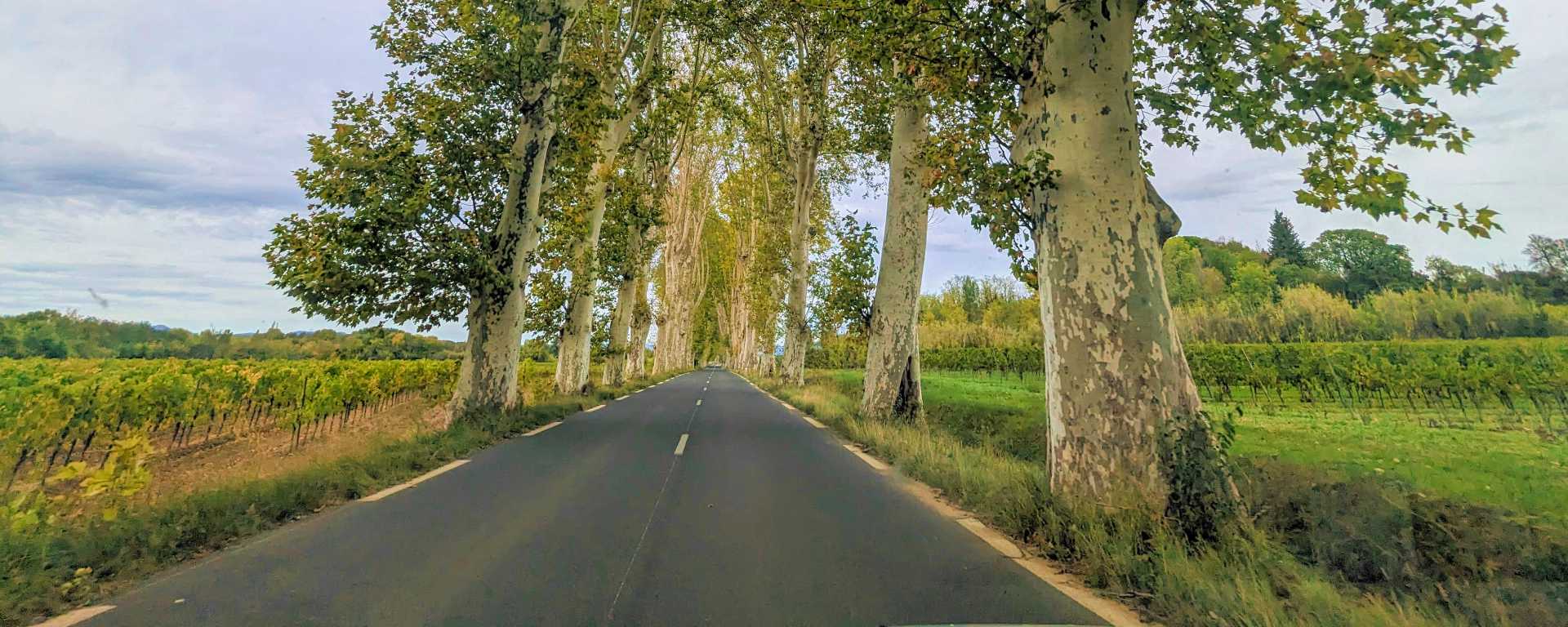
Once a road hell synonymous with traffic jams and holiday departures, the legendary Route Nationale 7 is now reinventing itself as a symbol of slow travel and retro heritage, stretching from Paris’s ‘kilometre zero’ to the Mediterranean. Join us step by step on a journey along the RN7.
Today it all begins at Place d’Italie – a name that evokes the Mediterranean – with a route that starts on the avenue of the same name, heading due south towards the Midi region.

The revival of a French motor racing legend
There was a time when the joy of the summer holidays was measured by how much patience one could muster. A time when the purr of an overheated Renault Dauphine*, the distinctive scent of the plane trees lining the road and the road map spread out on the bonnet marked the start of the great journey south. Immortalised by Charles Trenet and etched into the collective memory through the famous board game *Mille Bornes*, the Route Nationale 7, and its iconic acronym RN7, embodied for nearly half a century the great promise of paid holidays and the Mediterranean Sea.
However, with the opening of the ‘Autoroute du Soleil’ in 1974 –the A7 – and then the major decentralisation reform of 2006, which split the RN7 into a myriad of departmental roads (D607, D707 and even D907), the Nationale 7 nearly disappeared from the maps. Abandoned by hurried travellers and bypassed by a succession of diversion routes, it went through a long period of neglect, leaving in its wake ghostly petrol stations, deserted motels and sleepy villages enjoying their newfound tranquillity.
Today, an unprecedented phenomenon is breathing new life into these 1,000 kilometres linking Paris to Menton, on the border with Italy. In this era of ‘slow travel’*, the quest for authenticity and the rediscovery of local heritage, the N7 is enjoying a spectacular revival, particularly during the summer months. From the Place d’Italie to the winding roads of the Côte d’Azur, classic car enthusiasts, cycle tourists, budget-conscious drivers and fans of retro tourism are travelling the entire historic route – or parts of it – at speeds of 80, 90 and sometimes 110 km/h. With a route largely inspired by Adrien Serrière’s podcast*, we take a closer look at a French motorway that is slowly transforming the scars of its industrial past into a veritable tourist treasure, offering an alternative way to discover the regions of France it passes through: Île-de-France, Burgundy, Rhône-Alpes, Provence and the Côte d’Azur.
In Praise of Slowing Down: The RN7 as a Manifesto for Gentle Travel
To set off on your journey southwards in true 1950s style, the first step in embarking on a little adventure is to switch off your sat-nav. At any rate, that’s the advice from die-hard road enthusiasts, for whom old-fashioned navigation is an integral part of the experience.
“The problem with GPS today is that you follow the route without knowing where you are. A paper map gives you a sense of where you’re starting from, where you’re going, and how far you still have to go. On the N7, the actual route is almost always the straightest one, a legacy of the Roman era when people travelled on foot.” — Thierry Dubois, illustrator and historian of the Nationale 7.
Getting back behind the wheel of a classic car
Starting from Kilometre Zero at the Porte d’Italie in Paris, the urban landscape gradually gives way to the Forest of Fontainebleau. That’s where the magic happens. Behind the wheel of a 1957 Renault Dauphine or a gleaming Caravelle, the driving experience takes on a whole new dimension. The lack of air-conditioning is more than made up for by the windows rolled down to let in the forest breeze, and the three-speed gearbox sets a leisurely pace.
For motorists setting out on this stretch of tarmac, it is no longer a question of reaching their destination as quickly as possible, but of turning the journey itself into an experience. The speed limit becomes an opportunity: a chance to observe the ever-changing architecture of the country houses, to examine the old advertisements painted on the gables of barns, and to listen to the distinctive purr of vintage engines.
Le Relais des 200 Bornes: A culinary and historical stopover
Following the course of the Loire through the Loiret and then the Nièvre, travellers reach a symbolic milestone at the 200-kilometre mark. In Pouilly-sur-Loire stands a monument to French road culture: Le Relais des 200 Bornes.
Built between 1923 and 1926 during the golden age of motoring, this establishment is one of the few remaining examples of the nine iconic roadside inns that once dotted the route to the coast. Carefully restored by a pair of local restorers, Alexandra and Rémi, the place has retained its vintage petrol pumps on the forecourt and a vintage décor sourced from nostalgic customers.
Here, the stop isn’t just about the food (they still serve Loire-style fried fish, calf’s head and other slow-cooked dishes); it’s a social occasion. Drivers of classic cars now rub shoulders here with cycle tourists travelling along the ‘Loire à Vélo’ route and families in search of authentic road trips. Back in the days when vehicles required regular checks of water and oil every 200 kilometres, stopping off was a technical necessity. Today, it has become a stop-off for the sheer pleasure of tourism.
- The 200-bornes relay in Pouilly-sur-Loire
Discover this legendary spot with the radio feature from the programme *Si vous passez par là*:
💡 Facts & Figures: The RN7 in 5 key dates
- 1811: Napoleon I numbered the imperial roads. The Paris–Rome route was given the number 8, before becoming National Road 7 during the Restoration in 1824.
- 1936: The introduction of two weeks’ paid holiday by the Popular Front * turned the open road into a symbol of freedom and holidays for the masses.
- 1955: Charles Trenet recorded his famous song ‘Nationale 7’, cementing the cultural legend of the avenue.
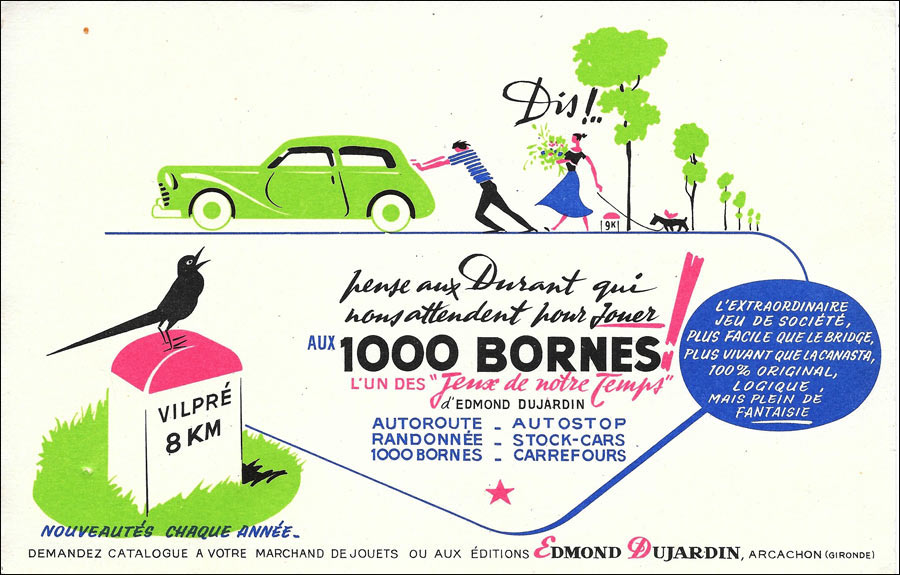
- 1954–1960: Creation of the board game *Mille Bornes* by Edmond Dujardin, directly inspired by the pitfalls and breakdowns encountered whilst travelling along the RN7.
- 2006: The Decentralisation Act transferred responsibility for the majority of the N7 to the departments, resulting in a change to its name on official signage.
From suffocation to serenity: The dilemma facing cities that lie along major transport routes
Whilst the RN7 now evokes a sense of fond nostalgia, its history is rife with contradictions. For the dozens of villages cut right through by this main road, the RN7 has long been both an economic blessing and a veritable daily nightmare.
The textbook case of Villeneuve-sur-Allier
Situated in the Allier department, some fifteen kilometres north of Moulins, the commune of Villeneuve-sur-Allier (population around 1,000) is a perfect example of this transformation. Until the bypass opened at the end of 2019, the village saw a constant stream of 15,000 vehicles a day, including more than 5,000 heavy goods vehicles.
For decades, the deafening noise of engines and the vibrations caused by lorries had undermined the residents’ quality of life. The historic façades had turned black from exhaust fumes, and the constant danger to pedestrians had gradually stifled the heart of the village.
In this radio report *, the mayor of the town, Dominique Desforges-Desamin, highlights a striking paradox:
- In themid-20th century, the high volume of traffic had given rise to a bustling commercial life, with as many as 13 pubs, 3 grocery shops and several garages for such a small village.
- As traffic turned the town into a congested bottleneck, motorists stopped stopping there due to a lack of sufficient parking spaces.
- As a result, by 2019, Villeneuve-sur-Allier had lost almost all of its shops, including its bakery.
Resurrection through circumvention
The opening of the bypass was seen as a relief. By freeing the town centre from heavy through-traffic, the town has regained a peace and quiet that had been forgotten for 50 years. This return to tranquillity has enabled the gradual return of local shops catering to residents, whilst paving the way for the former route to be reclaimed for tourism.
Far from erasing the RN7 from its identity, Villeneuve-sur-Allier is now seeking to turn it into a heritage asset. This pattern is repeated throughout the Rhône Valley and the Centre-Val de Loire region: once freed from traffic congestion, towns are rediscovering the historical value of their wide, tree-lined avenues – such as those lined with the famous plane trees – without the drawbacks of constant traffic flow.
💡 From the Roman road network to departmental fragmentation
- An ancient legacy: The route of the N7 largely follows the ancient Via Agrippa, which linked Lyon (Lugdunum) to Boulogne-sur-Mer, as well as the Roman roads serving southern Gaul. This straight route was dictated by the constraints of travel on foot and on horseback in ancient times.
- Historical total length: 996 kilometres between the forecourt of Notre-Dame de Paris (Point Zero of the French road network*) and the border post at Menton (Pont Saint-Ludovic).
- The 2006 reform: Under the decree of 5 December 2005, the State retained only certain strategic sections not duplicated by the A7 motorway under the designation RN7 (notably between Nevers and Roanne, and between Avignon and Aix-en-Provence). All other sections were transferred to the departments.
Open-air memory: When the road becomes a museum
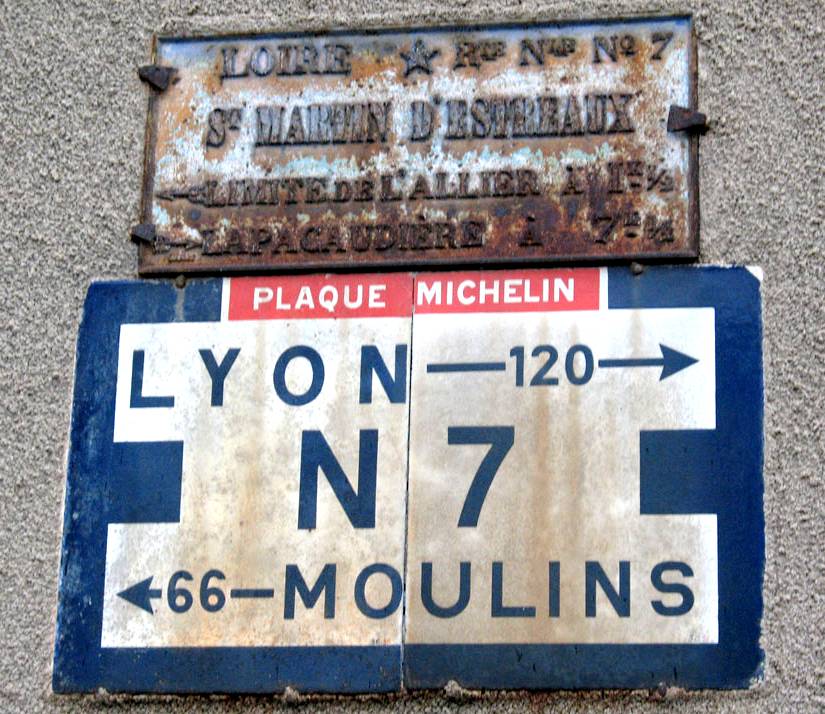
In response to the surge in popularity of retro tourism, a collaborative initiative has been launched between local councillors, classic car enthusiasts and road heritage historians. The aim is no longer simply to preserve the remains of the RN7, but to showcase the route in order to offer a truly immersive experience of the past century.
Vintage settings and historical re-enactments
All along the route of the RN7, innovative projects are taking shape.
In Villeneuve-sur-Allier, for example, the local council and collectors’ associations – such as the one led by Thierry Lacombe – are looking into the restoration of a disused section of the old national road. The project is an original one and proposes, rather than creating a modern and impersonal motorway service area, to meticulously recreate the period aesthetic with, for example:
- The removal of modern crash barriers in favour of historic bollards.
- The restoration of road markings: the re-application of the famous yellow lane-marking stripes, which were a hallmark of the post-war decades.
- Enhancing the tree-lined landscape: the bases of the plane tree trunks painted with white lime (a method formerly used to improve visibility at night).
- Reinstallation of vintage advertising hoardings: restoration of signs for brands of motor oil, soft drinks and regional aperitifs.
This development would allow travellers to park their cars at the side of the road and enjoy an old-fashioned picnic on the bonnet or next to a cool box, faithfully recreating the scenes photographed by the Rapho agency sixty years ago.
Elsewhere, as in Lapalisse, a mock traffic jam featuring vintage cars is re-enacted every two years on the Allée des Platanes, attracting over 100 vehicles and 25,000 people.
A vector of intergenerational transmission
This form of ‘memory tourism’ goes beyond mere nostalgia among older people who remember the big holiday departures of their childhood. It is attracting more and more younger generations in search of alternative travel experiences, cycle routes or itineraries far from the heavy traffic on major motorways.
By promoting this open-air museum, local authorities are able to attract visitors who spend their time in the area: stays in charming guesthouses, sampling local cuisine, visits to vineyards (from Pouilly-sur-Loire to the Côtes-du-Rhône) and stops at the small food shops that have been re-established in the centres of the towns and villages along the route.
💡 The global success of the game ‘Mille Bornes’
- An invention inspired by chance: It was whilst watching motorists with breakdowns on the RN7 that Edmond Dujardin, a publisher of driving school materials in Arcachon, came up with the idea for the game * Mille Bornes* in 1954.
- Road symbols: The game reimagines the real-life twists and turns of the journey from Paris to Menton. The iconic cards – Running Out of Petrol, Flat Tyre, Accident, Speed Limit and the famous Red Light attack that brings you to a sudden halt – are all taken directly from the everyday experiences of motorists on the N7 in the 1950s.
- A global success: Translated into more than 10 languages and with over 100 million copies sold since its launch, the game continues to bring the legend of the 1,000-kilometre stretch of the RN7 to life in homes all over the world.
National Road 7: a guide with stages and maps
At the end of this journey through the regions of France, one thing is clear: although the N7 has ceased to exist as an administrative road, it has successfully undergone a transformation and a rebirth. By losing its status as a priority route in favour of the A6 and A7 motorways and becoming a route for everyday local use, it has rediscovered what was at its very heart: the charm of the unexpected and the pleasure of the journey.
Route and geography
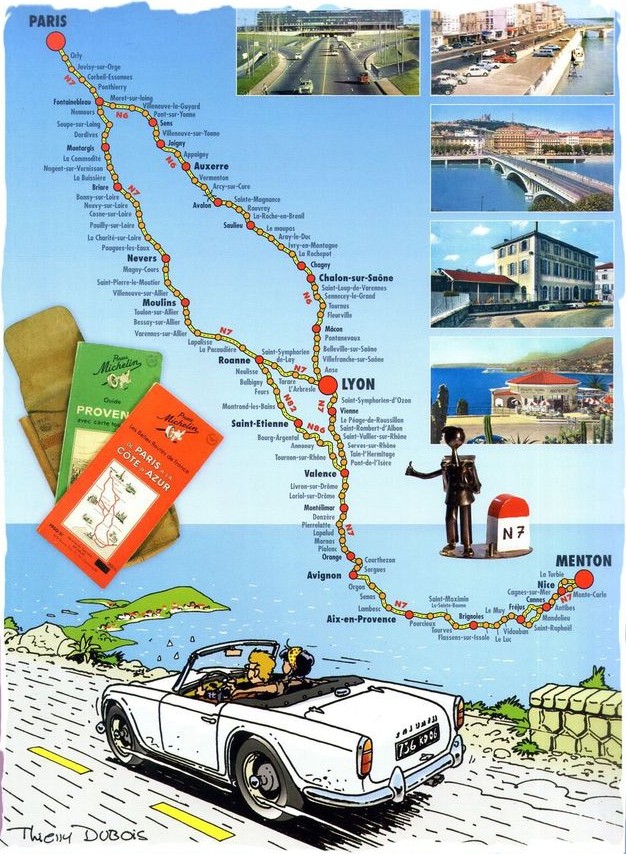
The historic route of the RN7 stretches for 996 kilometres from Paris to Menton, linking towns such as Fontainebleau, Nevers, Moulins, Roanne, Lyon, Valence, Avignon, Aix-en-Provence, Cannes and Nice, passing through 5 regions, 16 departments and local authorities:
- Paris (Île-de-France)
- Val-de-Marne
- Essonne
- Seine-et-Marne
- Loiret (Centre-Val de Loire)
- Nièvre (Burgundy-Franche-Comté)
- Allier (Auvergne-Rhône-Alpes)
- Loire
- Rhône
- Lyon Metropolitan Area
- Isère
- Drôme
- Vaucluse (Provence-Alpes-Côte d’Azur)
- Bouches-du-Rhône
- Var
- Alpes-Maritimes
The stages of the route in France:
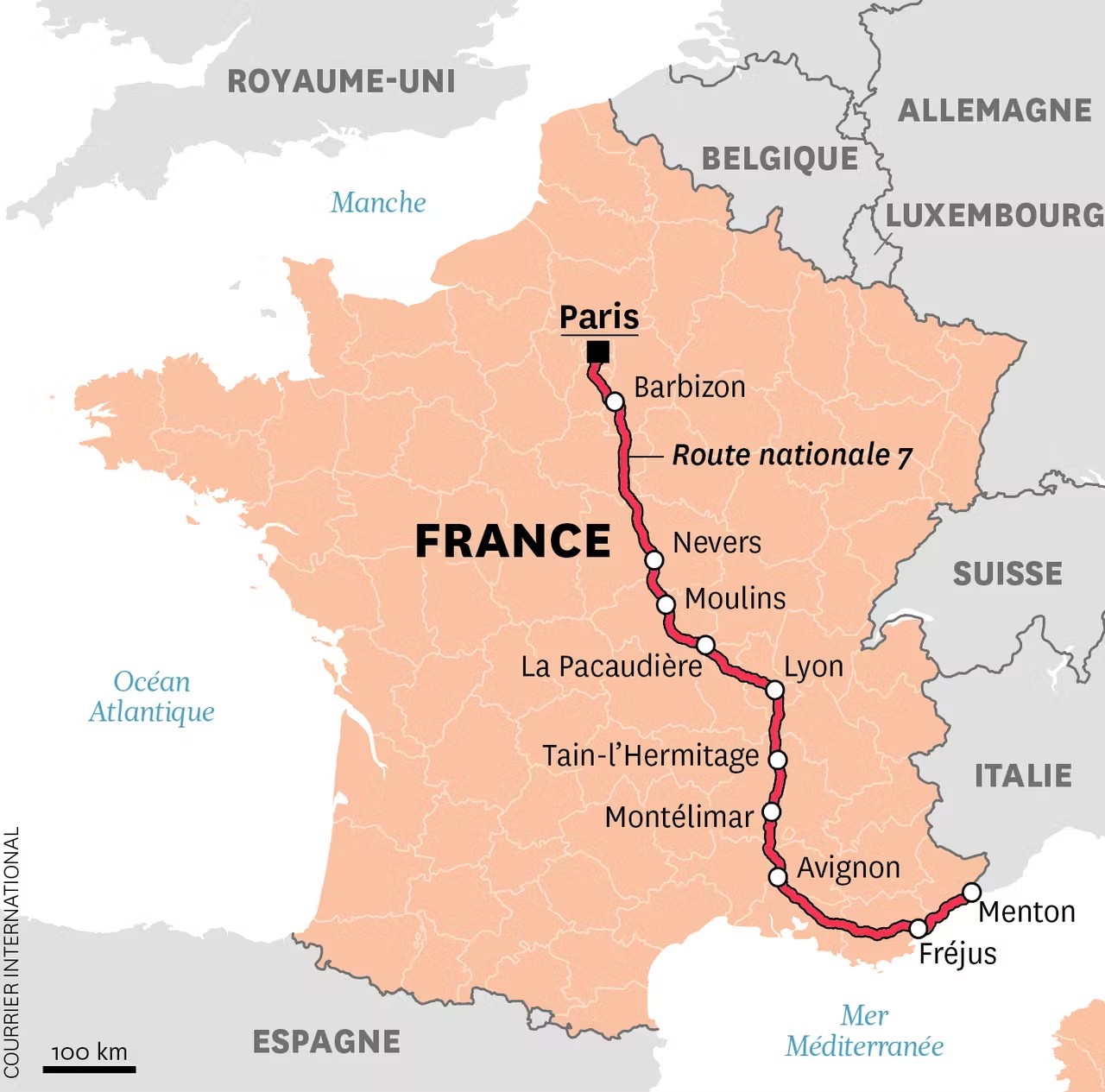
And to continue the journey, here are the main towns and cities along the route:
- Paris (Place de l’Italie and Avenue de l’Italie)
- Le Kremlin-Bicêtre
- Fontainebleau
- Nemours
- Montargis
- Briare
- Nevers
- Moulins
- Varennes-sur-Allier
- Lapalisse
- Roanne
- Tarare
- L’Arbresle
- Tassin-la-Demi-Lune
- Lyon
- Saint-Fons
- Vienna
- Tain l’Hermitage (Tournon-sur-Rhône)
- Valencia
- Montélimar
- Pierrelatte
- Orange
- Avignon
- Aix-en-Provence
- Le Luc
- Fréjus
- Cannes
- Nice
- Menton (on the border with Italy).
The key stages of the 7th
Highlights along the historic RN7 route, including key milestones and legendary locations:
[ Km 0 ] 📍 PARIS (Place d’Italie) / Île-de-France
│
├──► 🌲 [ 65 km ] FONTAINEBLEAU (Seine-et-Marne)
│ └─ A walk through the legendary forest, with that feeling of the holidays beginning.
│
├──► 🍇 [ 200 km ] POUILLY-SUR-LOIRE (Nièvre)
│ └─ Le Relais des 200 Bornes, a gourmet break along the Loire.
│
├──► 🏛️ [ 280 km ] VILLENEUVE-SUR-ALLIER (Allier)
│ └─ From a stifling village to a retro sanctuary lined with plane trees.
│
├──► ⛰️ [Km 430 ] COL DU PIN-BOUCHAIN (Loire / Rhône)
│ └─ Highest point on the N7 (759 metres above sea level).
│
├──► 🦁 [ Km 470 ] LYON (Rhône)
│ └─ Historic journey through the capital of Gaul.
│
├──► 🍑 [ Km 570 ] VALENCE & TAIN-L’HERMITAGE (Drôme)
│ └─ Entering the Rhône Valley, with its orchards and nougat.
│
├──► 🌿 [Km 700 ] ORGON & SENAS (Vaucluse / Bouches-du-Rhône)
│ └─ Provençal roads lined with rows of plane trees.
│
├──► ☀️ [Km 780 ] AIX-EN-PROVENCE (Bouches-du-Rhône)
│ └─ Heading east towards the Mediterranean coast.
│
▼
[ Km 996 ] 🌊 MENTON (Alpes-Maritimes) — Italian border
Map of the RN7
Historic route, road log, Michelin itinerary, and 9 stages from Paris to Menton—a single map capturing the entire geography of the Route Nationale 7 in France:

Michelin map
And to see the N7 road trip and other suggestions in France all on one map, here is the dedicated Michelin map:
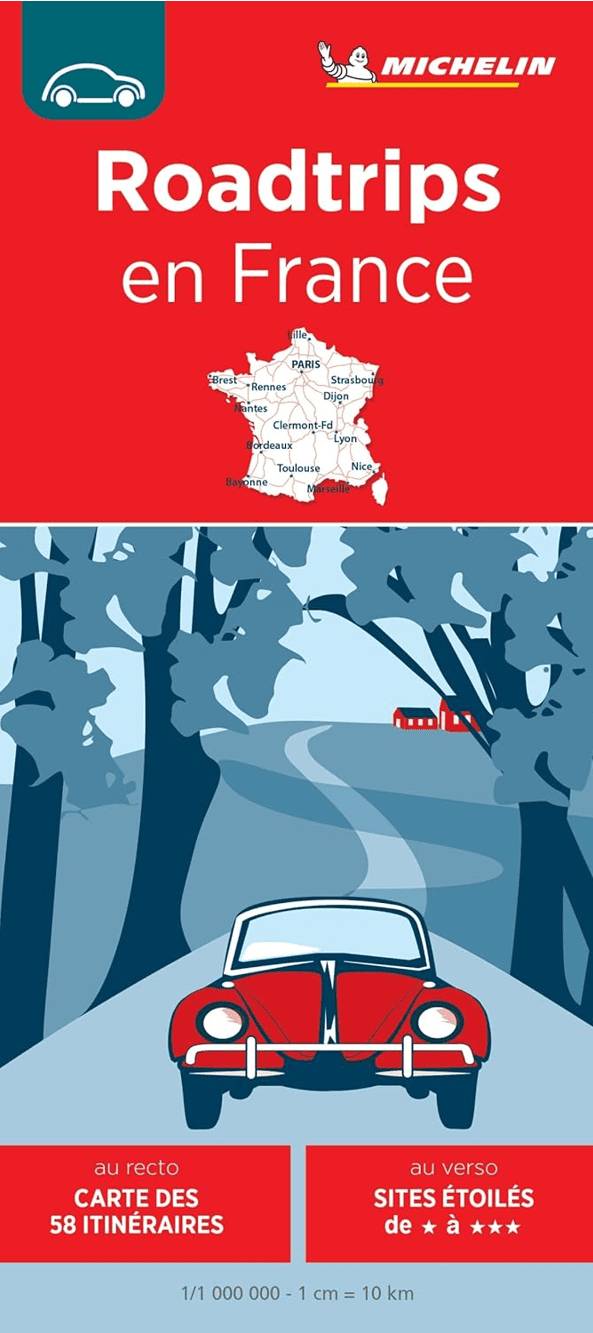
➡ See also: Atlas of roads and road maps of France
Beyond the towns and stops along the way, the N7 is no longer just a road designed to get you from A to B as quickly as possible; it has once again become a destination in its own right. Travelling along the RN7 today means taking your time, chatting with a passionate restaurant owner in Pouilly-sur-Loire, to admire the architecture of a well-preserved village in the Allier, to stop at a suspension bridge designed by Marc Seguin in Tain-l’Hermitage, and in doing so to rediscover an intimate side of France, all within easy reach by car.
At a time when the global tourism industry is re-evaluating its business models and seeking to promote more sustainable forms of travel that are more deeply rooted in local communities, the Great Southern Road offers an intriguing solution. A century-old stretch of tarmac where French history is still being written, to the gentle rhythm of the engines of yesteryear and the travellers of today.
The N7, on the radio and in videos
- It’s yet another popular road: the N7
A radio report by Adrien Serrière, with sound recording by Clément Vuillet and Mael Larfa Saur, broadcast on Radio France as part of the programme *Interception* on 5 July 2026 (27 minutes):
The N7, the legendary holiday route that once linked Paris to Menton, is once again proving popular with travellers seeking to relive childhood memories or enjoy a more leisurely journey. All along the route, a new form of tourism is gradually taking shape.
“Of all the roads in France,” as Charles Trenet sang, this is the one that leads “towards the shores of the south”, the one that saw its peak traffic during the summers of the 1950s and 1960s, before the motorways were built. In this report, Adrien Serrière sets out to retrace the historic route of this road, which was decommissioned in 2006 and remains a source of fascination for classic car enthusiasts.
- A drive along a legendary French road with Karambolage
In less than 4 minutes, Michel Souris tells the story of the Royal Road No. 7, which became a national road in 1824:
- ‘1 Week on Nature 7’ for the holidays, INA archive
A news report from July 1968 follows a journey from Paris to Nice along the Route Nationale 7, amidst the holiday exodus. It shows accidents, traffic jams, roadside restaurants and scenes of everyday life on this busy road (26 minutes):
This report takes place over a week in July 1968. The journalists set off on a journey from Paris to Nice.
On the road, they come across a horrific accident and interview the injured. They meet an American family visiting France, who are raiding the ice-cream dispensers at petrol stations. They then meet a couple from Aubervilliers who have bought a small cottage by the side of the N7. Residents living by the roadside talk about people heading off on holiday. Three students are cycling to the Côte d’Azur and recount their journey. Traffic congestion and roadworks on the N7 make travelling perilous, with numerous accidents occurring there. The report also looks at roadside restaurants. Mr Barnier, a restaurant owner, shows us how to cross the N7 using a very particular – and dangerous – method. The reporters then come across horses travelling along the N7 in Provence.
Travel link
- Renault Dauphine, Wikipedia ↗
- Slow Tourism, Wikipedia ↗
- Downgrading of the RN7 ↗
- The 1,000-kilometre game, FNAC ↗
- National Road 7, Radio France podcasts ↗
- Travelling along the N7 is like taking a journey back in time, The Guardian / Courrier International ↗
- History, heritage and memories of a legendary route, RCF podcast ↗
- The Popular Front introduced paid holidays across the board (1936), EHNE ↗
- Road trip on the N7, ViaMichelin ↗
- A few photos, Jéremy Saint-Peyre ↗
Voyage+France