
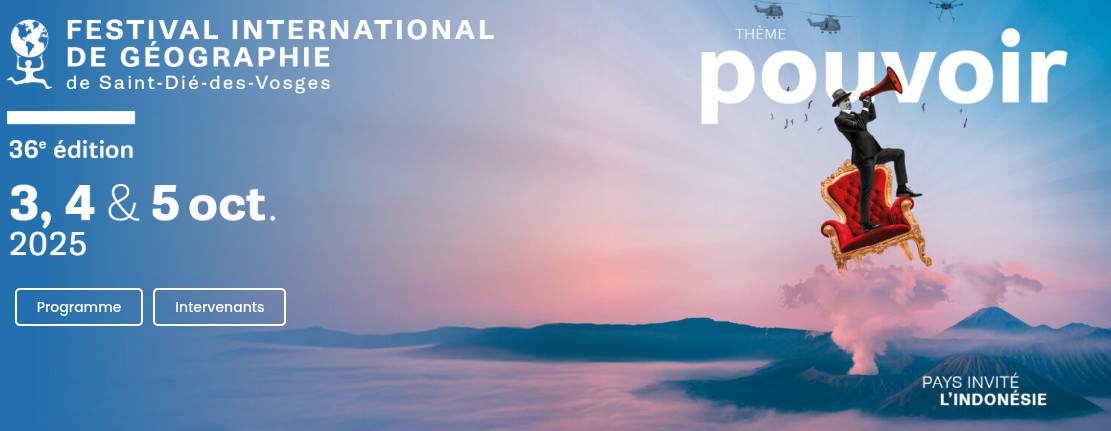
Every early autumn, Saint-Dié-des-Vosges is transformed into an open-air university: a free festival that brings together nearly 40,000 participants, researchers, authors and the curious, to explore the world through maps, ideas and terrain.

The International Geography Festival
Founded in 1990 in Saint-Dié-des-Vosges, the International Geography Festival (FIG) has established itself as a major event in the Grand Est region, attracting a wide audience to the discipline and its players every early autumn.
It has a dual vocation: as a forum for debate and discovery for researchers, teachers, authors and the curious, and as an active mediator for shedding light on the contemporary world through geography. The sheer scale of the event, made all the more popular by its accessible formats, makes it an “open-air university” that focuses on fundamental subjects as much as on practical issues in the field.
Each year the FIG focuses on a theme and a guest country, combining conferences, debates, a book fair and digital geography to bring geography alive and accessible.
Venues, formats and access
For three days, the city is transformed into an archipelago of cultural and civic venues hosting conferences, talks, round tables, screenings, exhibitions, performances and literary encounters.
Frequent sites include the Espace Georges-Sadoul, La Boussole, the Espace François-Mitterrand, the Tour de la Liberté, the Parc Jean-Mansuy and the Place du Marché, which structure the flow of visitors. The programme is easy to read, with colour-coded headings for debates, literature, geo-digital, gastronomy, cinema and events for young people.
All events are free of charge, subject to availability, with a free ticket office open on site about thirty minutes before each event. A strong incentive for soft mobility is offered by the TER Fluo Grand Est partnership , with a €1 return ticket available on presentation of proof of identity at the festival reception desk.
The reception area, at the foot of the Tour de la Liberté, provides information, guidance and a shop, in liaison with the tourist operators in the Vosges Massif.
The 2025 theme: Power
The 2025 edition will be held from 3 to 5 October on the theme of ‘Power’, with a programme that examines power relations, the ability to act and contemporary geopolitical and societal changes.
The scientific committee emphasises comparative and cross-disciplinary approaches, from the international scale to urban, economic, religious and digital issues. We take a proactive approach to current affairs, organising special events to decipher crises and shed light on responsibilities and possible alternatives.
The 2025 edition will feature around 250 free events, including conferences, meetings, book signings, screenings, shows and workshops. This density, which can be seen in the chronological programme for each day, leaves plenty of room for breathing space and transitions between sites. The balance between academic events, discussions, workshops and activities for young people is the hallmark of the event.
Guest in 2025
Indonesia is the guest country, offering an archipelago perspective on cultural, demographic and environmental diversity, and a key maritime and geopolitical prism. The presentations cover topics ranging from natural resources and risks to the dynamics of urbanisation, youth and linguistic and religious plurality.
The country serves as a mirror for the debates on the theme of “Power”, between national trajectories, regional strategies and global interdependencies.
Faces 2025
Climatologist Valérie Masson-Delmotte will be chairing FIG 2025, underlining the importance of scientific issues and communication at the heart of the event. Journalist Raphaëlle Bacqué will be taking part as a key witness, with an investigative look at the mechanisms of influence and the narratives of power. Indonesian writer Eka Kurniawan will be chairing the Salon du Livre, embodying the link between literature, territory and geographical imagination.
Awards and distinctions
The Vautrin-Lud Prize is awarded to a geographer for a body of work, and in 2025 the winner will be Anssi Paasi, a leading figure in political geography and regional identities. A lecture will be given at La Boussole on Sunday morning, before the prize-giving ceremony at the Espace Georges-Sadoul on Sunday at 3.30pm. This is a major event, and one in which the FIG will be following in the footsteps of other major international awards.

Geographic spaces in Saint-Dié
Places, meetings and themes around the Festival internationel de géographie.
Geographic Book Fair
Billed as the biggest geography bookshop in France, the Salon du Livre brings together over 60 publishers and welcomes over a hundred authors to sign books at the Parc Jean-Mansuy. Literary events punctuate the weekend, with cafés, meetings, breakfasts and discounts, and partner press supplements to extend the debates. The 2025 edition will feature a number of publishing initiatives around the theme of “Power” and the guest country, echoing the conferences.
Geo-digital
Espace Géo-Numérique, co-organised with AFIGEO 1, is an exhibition for the general public dedicated to cartographic and geomatic innovation, with around thirty exhibitors, workshops and mini-conferences. The trades and skills involved in the cartographic chain are highlighted, from paper to embedded applications, with a view to passing on knowledge and providing guidance. Initiatives such as La République des cartes 2 are promoting the civic role of cartography and its democratic levers.
Education
The National Training Programme (PNF) 3 offers dedicated sessions for teachers, combining resources, feedback and exchanges with academics, inspectors and trainers. Practical workshops for secondary school teachers use digital tools and case studies (gentrification, the Strait of Malacca, sketches and virtual visits). A “geographical speed-meeting” format and “Understanding the news” sessions provide opportunities for direct interaction between specialists and the general public.
Audiences and families
FIG Junior offers a range of activities for children and teenagers, including workshops, games, meetings and a children’s section at the Book Fair. Activities such as the planetarium and screenings for young audiences complete the range of activities on offer, in specially adapted and supervised settings. Fun activities focusing on the environment, biodiversity and cartography are also on offer to help children get to grips with the tools of geography for the first time.
Exhibitions
Exhibitions will be staged throughout the city and at the festival venues, bringing together maps, photography, sound and documentaries in formats designed to encourage visitors to wander around. An exhibition designed by cartographers from Le Monde newspaper offers a visual treatment of a major conflict, complementing the major meetings. The art gallery at the Cour des arts géographiques also offers an original mix of shows, exhibitions, concerts and workshops devoted to the visual arts.
Gastronomy and eco-responsibility
The Place de la Gastronomie and theÉco Resto will be offering demonstrations and a range of culinary delights, with nods to Indonesia and a focus on local and sustainable food.
The festival is also strengthening its environmental commitments: waste management, mobility, short circuits, local partnerships, and is launching a carbon footprint assessment in 2025. A mobility survey of festival-goers is helping to objectify flows and guide measurable actions to reduce the festival’s carbon footprint.
A city on stage
Saint-Dié-des-Vosges serves as a showcase and a stage, with its cultural facilities and public spaces organised around the various FIG centres. The involvement of regional players such as the Massif des Vosges(Alsace Destination Tourisme *) and media partners is helping to ensure that the FIG is firmly rooted at local level, with an eye to global issues. This territorial anchoring encourages fluid circulation between intellectual, practical and festive centres.
Practical Saint-Dié
Transport, accommodation and links for the Vosges Geography Festival.
Going to Saint-Dié-des-Vosges
By train, via theTERFluo Grand Est network and the Lunéville-Strasbourg railway line.
By bus, with the Vosges departmental bus network
By car, to the Meurthe valley
By bike, from the Voie Bleue Moselle-Saône and Eurovelo 5
Where is it?
At Saint-Dié in the department, here is the essential location map:
Links and programme
For more information, the programme and links, visit the official festival website:

Travel link
- Tourist Offices in Alsace, Haut and Bas-Rhin
- French Association for Geographic Information, Afigéo ↩︎
- Republic of Cards, the collective ↩︎
- National Training Programme (PNF), Ministry of Education, Educsol ↩︎